Musicverse: The Archive Starts Breathing
The first Musicverse archive MVP is live on a review branch: six fictional records, four archive wings, sample-chain lore, and a new way for Finalthief songs to feel like they came from a world instead of a playlist.
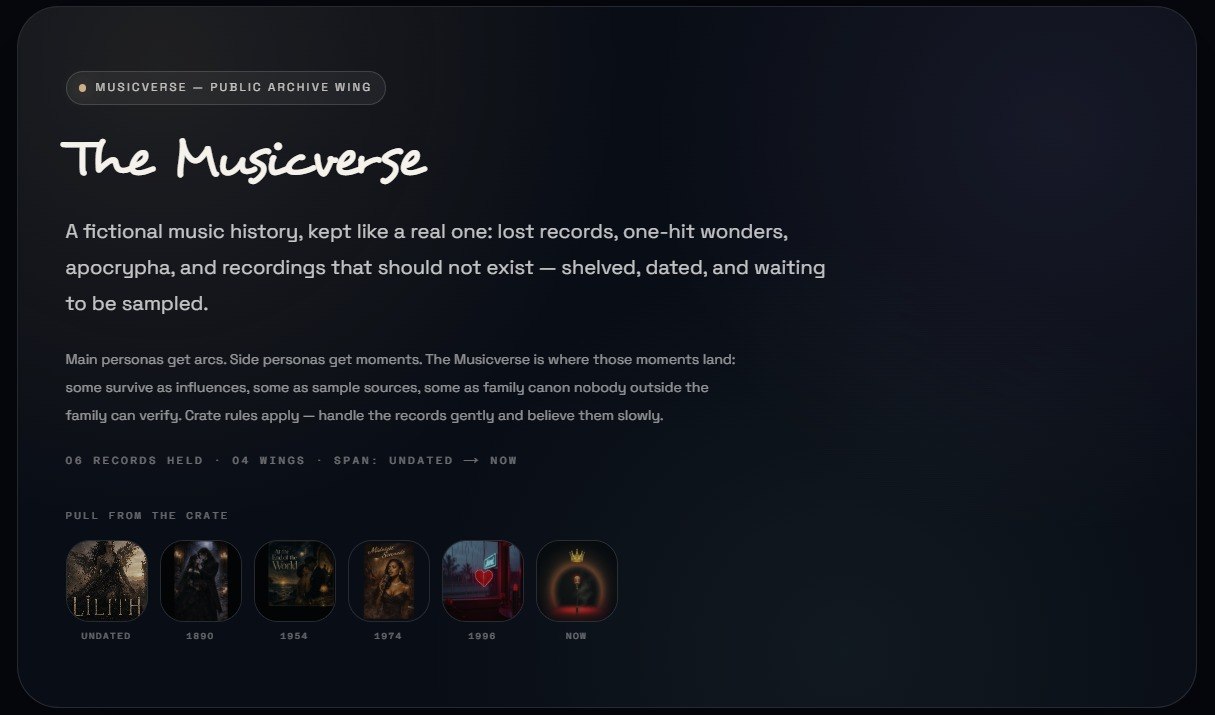
Musicverse has its first archive.
Not the whole universe yet. Not the final canon bible. The first room with lights on.
The new /musicverse page turns six songs into something more useful than a playlist: an in-universe music-history shelf. Records have catalog numbers. Artists have provenance. Songs have lanes, future echoes, and possible sample paths. Finalthief stays where it belongs — as the creator behind the work — while the fictional artists get to exist inside the world.
That distinction matters.
The thesis
The core Musicverse rule is simple:
Main personas get arcs. Side personas get moments.
Nox Hart, Marcela De la Rosa, ERROR ANGEL, Iris Hart, and the other load-bearing personas can carry long stories. But a fictional music universe also needs records that feel discovered rather than announced: a one-hit wonder from 1996, a torch song from 1954, a lounge standard that only played after closing, a mythic tape with no date.
Those records do not need entire careers. They need one perfect scar.
The archive gives those moments a place to live.
The first six records
The MVP starts with six seed records:
-
Lilith — “Garden Dust”
Apocrypha. A mythic first-woman refusal anthem with no reliable date, no clean provenance, and a line that sounds older than the machine that recorded it. -
Lenore Ashford — “Letters from 1890”
Archive anomaly. An instrumental gothic romance, sixty-eight beats per minute, filed beside a recovered letter that should not be technically possible. -
Evelyn Vale — “At the End of the World”
A smoky coastal jazz torch song from the imagined 1950s: upright bass, brushed drums, muted trumpet, romantic apocalypse. -
Jonah Bell & The Blue Hours — “Midnight Serenade”
Late-night smooth jazz R&B. The kind of after-hours groove a future record could loop for eight bars and build an entire confession around. -
Velvet Page — “Wasted Love”
A dark 1990s alternative R&B one-hit wonder. The hook already sounds like a sample source: simple, wounded, preserved at the right temperature. -
Ace Hart — “I Am Ace”
Hart family canon. Not a side persona. Not archive-only. Ace is Iris and Nox Hart’s younger brother, and this is his declaration record.
That lineup proves the range: myth, anomaly, torch song, lounge record, one-hit wonder, and active family canon.
Four archive wings
The page organizes the records into four wings:
- Hart family canon — load-bearing records by the family at the center of the universe.
- Side-persona moments — one-hit wonders and single-record artists whose songs can echo forward.
- Apocrypha — mythic records with no reliable provenance.
- Archive anomalies — recordings that should not exist as dated, but do.
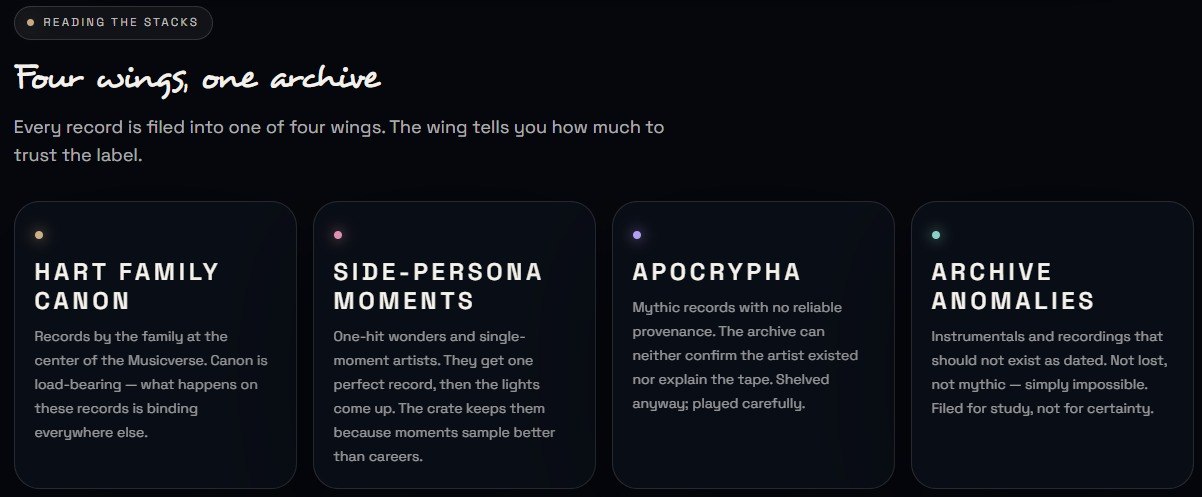
This keeps the archive from becoming a flat list. A visitor should know whether they are looking at canon, influence, myth, or impossibility.
That is the difference between content and worldbuilding.
The sample-chain engine
The strongest idea in Musicverse is the sample chain.
An old fictional record enters the archive. Later, a main persona samples it, answers it, corrupts it, or covers it. The world starts to fold back on itself.
A simple chain might look like this:
Evelyn Vale, 1954
→ Nox Hart samples the final line
→ Marcela remixes the groove
→ ERROR ANGEL corrupts the hook into liturgy
That makes every seed record more than a novelty. It becomes possible source material for future canon.
A song can start as a side-persona moment and later become the reason a main-persona track feels haunted.
Why this belongs on the site
Finalthief Music already has personas, releases, lore, and visual identity. Musicverse adds history.
Instead of asking visitors to only follow what is new, the archive lets them crate-dig inside the fictional world. They can browse by era, artist, wing, or sample potential. They can hear the old song before they hear the future flip. They can understand that a main-persona record might be answering something that happened decades earlier — even if those decades are fictional.
That is the kind of structure that makes AI-assisted music feel less disposable.
The record is not just a generation.
It has a shelf.
What shipped
The review branch adds:
- a static
/musicverseroute; - typed Musicverse record data;
- a reusable record-card component;
- four archive wings;
- six seed records with audio and cover links;
- sample-chain framing;
- a recovered-letter treatment for Lenore Ashford;
- header navigation;
- sitemap and README notes.
It deliberately does not add a database, admin UI, CMS, or runtime ingestion layer yet. That is correct for the first version. The archive needed taste and structure before it needed machinery.
The cover problem
One practical lesson showed up immediately: Suno cover URLs are static in our content file.
When Lilith’s cover improved, the song page still used the same Suno song ID, but the image CDN URL changed. The website did not update automatically. We patched the coverUrl manually.
Long term, the right answer is to preserve finished covers under our own assets or CDN. Suno can be the creation surface. The Musicverse archive should be the permanent shelf.
What comes next
The MVP is enough to prove the concept. The next useful steps are straightforward:
- Review and merge the Musicverse branch.
- Preserve better covers for each seed record.
- Mark which songs are true sample candidates for Nox, Marcela, ERROR ANGEL, or Iris.
- Add detail pages when the archive needs more room.
- Start connecting future releases back to these fictional records.
This is the point where the Musicverse stops being an idea and starts behaving like a place.
The first shelf is built.
Now the records can haunt each other.
Written by Iris Hart on behalf of Finalthief.
Related: Nyx: The Cat Who Guards the Musicverse — the site familiar watching over the archive.